
Tailgate Ridge is reader-supported. When you buy through links on this page, we may earn a commission at no extra cost to you. Read our affiliate disclosure.
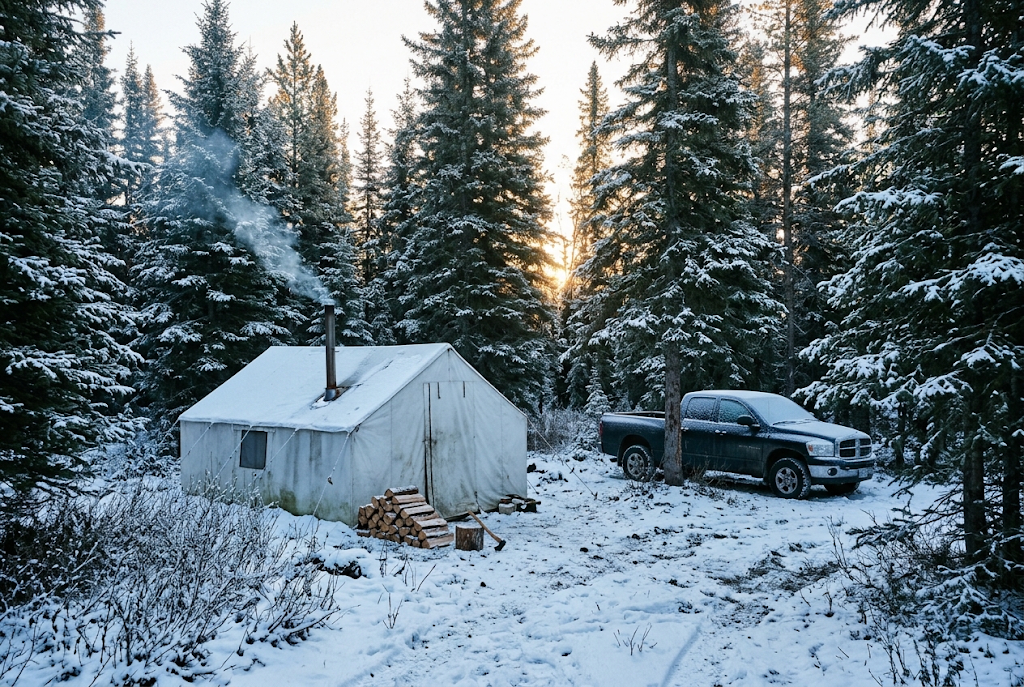
It is 4 a.m. in camp. There is frost on the inside of the tent wall, your boots are stiff, and the last thing you want to do is crawl out of a warm bag. A good tent heater fixes that in about ten minutes. A bad one, or a good one run the wrong way, can kill you before the alarm goes off.
This guide covers the tent heaters worth packing for a cold-weather hunting camp, which type fits your setup (truck topper, dome tent, or canvas wall tent), and the safety rules that matter more than any product pick. The picks are based on research and owner reviews.
Quick picks
Best overall
Mr. Heater Big Buddy: three heat settings and enough output for a wall tent. Jump to review
Best for truck toppers and small tents
Mr. Heater Portable Buddy: the classic Buddy heater in a size that fits a topper. Jump to review
Best budget
Mr. Heater Little Buddy: screws onto a 1 lb cylinder and warms a one-person tent or blind. Jump to review
Best for wall tents
Camp Chef Alpine: wood stove kit with pipe and spark arrestor in the box. Jump to review
Best diesel
Autoterm Travel Box 2.0: burner and exhaust stay outside, dry heat ducts in. Jump to review
Best electric
Lasko 754201: no flame and no CO, for camps with hookup power. Jump to review
Compare the picks
| Pick | Best for | Fuel | Heat output | Safety features | Cost ($ to $$$$) |
|---|---|---|---|---|---|
| Mr. Heater Big Buddy (MH18B) | Best overall, bigger tents | Propane (two 1 lb or a 20 lb with hose) | 4,000 / 9,000 / 18,000 BTU | Low-oxygen shutoff, tip-over shutoff | $$ |
| Mr. Heater Portable Buddy (MH9BX) | Small tents and truck toppers | Propane (1 lb, or 20 lb with hose and filter) | 4,000 / 9,000 BTU | Low-oxygen shutoff, tip-over shutoff | $$ |
| Mr. Heater Little Buddy (MH4B) | Budget, one-person tents and blinds | Propane (1 lb) | 3,800 BTU | Low-oxygen shutoff, tip-over shutoff | $ |
| Camp Chef Alpine Heavy Duty Cylinder Stove | Canvas wall tents with a stove jack | Wood | Not listed by Camp Chef | Spark arrestor, door damper | $$$ |
| Autoterm Travel Box 2.0 | Diesel heat with the burner outside | Diesel | 2 kW (about 6,800 BTU) | Exhaust stays outside, warm air ducted in | $$$$ |
| Lasko 754201 ceramic heater | Camps with hookup power | Electric (120V) | 900 W / 1,500 W | Tip-over switch, overheat protection, cool-touch housing | $ |
Safety first: read this before you heat a tent
Read this before you buy anything. Every fuel-burning heater makes carbon monoxide (CO). You cannot see it or smell it, and early symptoms feel like the flu: headache, dizziness, nausea. In a closed tent at night, people do not always wake up.
- Run a CO alarm in the tent every time. Use a battery-powered CO alarm listed to UL 2034 and put it near where you sleep. Test it before the trip.
- Ventilate, even when it is cold. Mr. Heater’s manuals call for a fresh-air opening at the ceiling and at floor level: at least 9 square inches for the Portable Buddy and 18 square inches for the Big Buddy. Open vents both high and low.
- Do not run it while you sleep. The Buddy and Big Buddy manuals both say, in capital letters, never operate the heater while sleeping and never leave it unattended. Heat the tent before bed and when you wake up, then shut it off.
- Give it room. The Buddy manuals list clearances of 30 inches above, 24 inches in front and 6 inches to the sides. Keep sleeping bags, tent walls and wet clothes out of that zone, and set the heater on a flat, stable base.
- Know your altitude. The Mr. Heater Buddy line is rated to 7,000 feet. Above that, the heater may burn poorly or shut itself off.
- Never bring these inside a tent: generators, charcoal, grills, or camp stoves used as heaters.
- Wood stoves only in tents built for them: a canvas tent with a proper stove jack, a spark arrestor on the pipe, and someone keeping an eye on the fire.
A note on the “indoor-safe” label. Mr. Heater markets the Buddy heaters as indoor-safe and lists tents among their uses, and they have a low-oxygen shutoff that the cheap knockoffs often lack. But the Big Buddy owner’s manual still carries a general warning that the appliance can produce carbon monoxide and should never be used in an enclosed space such as a tent or camper. Read that as: the shutoffs help, they do not make CO go away. Ventilation and a CO alarm are not optional.
Tent heater safety checklist (screenshot this)
- CO alarm in the tent, battery tested
- Vents open high and low
- Heater on a flat, stable base
- 30 inches clear above, 24 inches in front
- Heater off before you sleep
- Never a generator, grill or charcoal inside
- Wood stove only with a stove jack and spark arrestor
Types of tent heaters, and who each one is for
Portable propane (radiant)
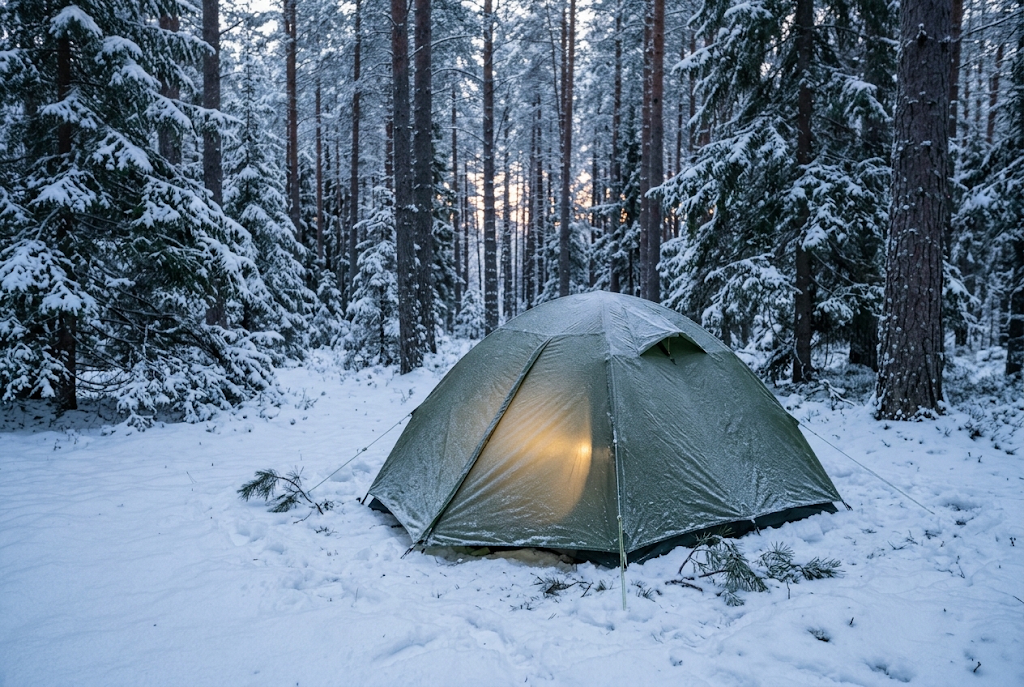
The most common hunt camp heater, and the right call for most people. No power needed, heat in minutes, and the Mr. Heater Buddy family adds low-oxygen and tip-over shutoffs. The downsides: CO and water vapor in the tent, fuel to haul, and 1 lb cylinders that struggle in deep cold. Best for dome tents, truck toppers and smaller wall tents.
Wood stoves for wall tents
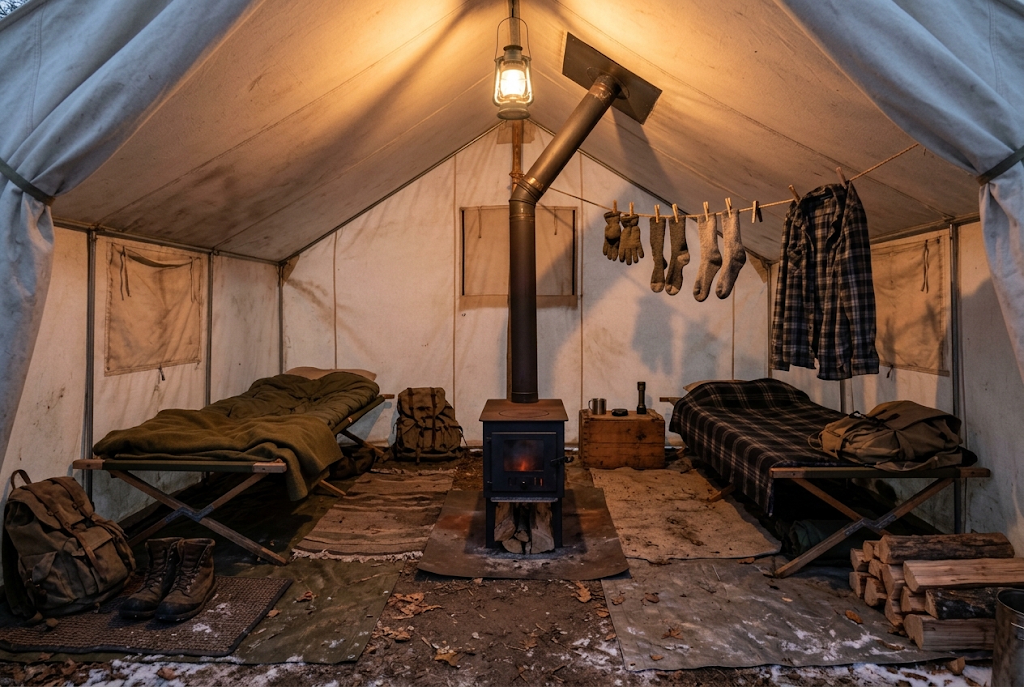
Dry heat, cheap fuel, and a place to boil water or dry socks. You need a canvas tent with a stove jack, a pipe with a spark arrestor, and dry wood, and somebody has to tend it. Best for a base camp that stays put for a week of elk or deer season.
Diesel air heaters
A diesel heater burns fuel in a sealed chamber and blows warm, dry air into the tent through a duct, with the exhaust kept outside. Done right, that is the cleanest heat you can get in a tent. Done wrong, it is the most dangerous. Units like the Autoterm Travel Box 2.0 are built to sit outside and duct heat in. Cheap all-in-one units are often sold for vehicles and need care to set up so the exhaust stays outside and away from the tent.
Electric heaters
No combustion, so no CO from the heater itself. The catch is power. A 900-watt heater uses about 900 watt-hours in an hour, which is roughly the whole battery of a 1,000 Wh power station before conversion losses. Electric makes sense with a campground hookup or a generator running well outside the tent, not off a power station all night.
How to choose a tent heater
Match the heater to the tent
Mr. Heater rates its heaters by area: up to 95 square feet for the Little Buddy, up to 225 for the Portable Buddy and up to 450 for the Big Buddy. Those ratings are the maker’s. A thin tent wall loses heat far faster than a building, so treat the rating as a ceiling and size up when it is cold or windy.
| Tent | Floor area | Propane heater that fits |
|---|---|---|
| 1-person tent or ground blind | Under 60 sq ft | Little Buddy |
| Truck topper or 2 to 3 person dome | About 50 to 100 sq ft | Little Buddy or Portable Buddy |
| 4 to 6 person tent | About 100 to 150 sq ft | Portable Buddy |
| 10×12 to 12×14 wall tent | 120 to 168 sq ft | Big Buddy |
| 14×16 wall tent and up | 224 sq ft and up | Big Buddy, or a wood stove |
What real-world warm-up looks like: In Bob Vila’s hands-on review, the Portable Buddy took about 30 minutes to raise a 180 sq ft room from 70°F to 78°F, and that was an insulated room in mild weather. Field & Stream’s reviewer said it warmed a garage in under 30 minutes, but that wind can carry the heat away outdoors. A tent leaks heat far faster than either. Canvas-tent owners on Rokslide describe the top of the tent getting comfortable within minutes while the floor stays cold, so size up and keep your sleep system rated for the night’s low.
Fuel, runtime and cold
1 lb cylinders are convenient but run out fast and lose pressure in the cold. Mr. Heater lists the Portable Buddy at about 3 hours on high and 6 hours on low per cylinder. The Big Buddy manual recommends a 20 lb tank for continuous use below 20°F, and strongly recommends Mr. Heater’s disposable fuel filter (part F273699) when you run a hose from a bulk tank, to catch oily residue that can clog the heater.
Altitude
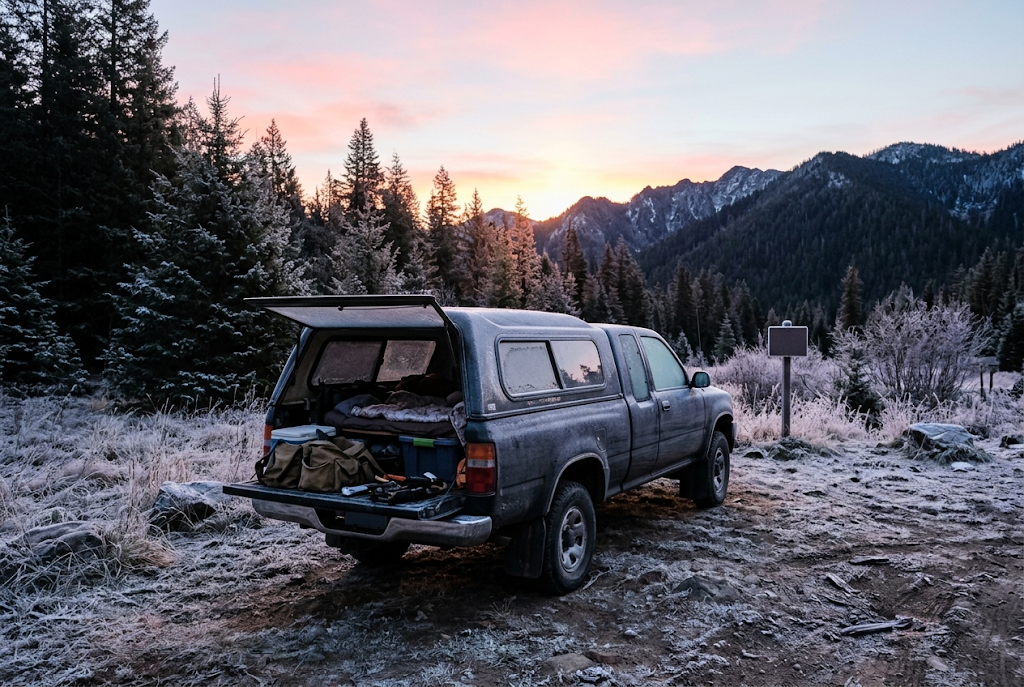
Western hunters take note: the Buddy heaters are rated to 7,000 feet. If you hunt above that, plan on a wood stove or a diesel heater with a high-altitude rating. The Autoterm Travel Box 2.0 lists a maximum of about 9,800 feet.
Moisture and condensation
Burning propane puts water vapor into the tent. Expect damp walls and gear unless you vent well. Wood stoves and diesel heaters make dry heat, which is a big part of why wall-tent camps love them.
Weight and packability
From a truck, weight barely matters. The Little Buddy weighs under 6 pounds, the Portable Buddy about 11 and the Big Buddy about 17. A steel cylinder stove plus pipe is a bigger load and needs truck or pack-animal access.
The best tent heaters for hunting camp
1. Mr. Heater Big Buddy (MH18B): best overall
Best for: wall tents and bigger tents where one heater has to warm the whole space.
- Heat: 4,000, 9,000 or 18,000 BTU per hour
- Area: up to 450 sq ft (maker’s rating)
- Fuel: two 1 lb cylinders, or a 20 lb tank with a hose sold separately
- Safety: low-oxygen shutoff, tip-over shutoff
- Weight: about 17 lb; rated to 7,000 ft
Three heat settings is what makes the Big Buddy the default hunt camp heater. Run it on high to knock the frost off in the morning, then turn it down. It takes two 1 lb cylinders or a bulk tank, so it fits both quick trips and week-long camps.
Watch out for: Mr. Heater says it removed the fan from some MH18B units because of tariff changes, so check the listing if you want the fan. It is not for sale in Massachusetts or Canada. Price seen: $159.99 at U-Haul on Nov 16, 2026.
What owners and reviewers report:
- Owners like the three settings most: warm the tent on high, then drop to medium or low. Sam’s Club shoppers rated it 4.4 out of 5 from 159 ratings when we checked on Nov 16, 2026.
- The most common failure is clogging from oily residue when it runs off a 20 lb tank. Owners on Rokslide trace many dead heaters to it, and Mr. Heater recommends starting each season with a new fuel filter.
- Pilot and ignition trouble comes up often. Mr. Heater’s fix: hold the start knob for 30 to 60 seconds after hooking up new fuel, and clean the pilot tube with an alcohol-soaked swab.
- Mr. Heater says a single 1 lb cylinder cannot feed the 18,000 BTU high setting. Run two cylinders or a bulk tank.
- Some owners report failures after about two seasons and say it is hard to take apart for repair.
2. Mr. Heater Portable Buddy (MH9BX): best for small tents and truck toppers
Best for: truck bed toppers, dome tents and anyone who wants the proven heater in a smaller size.
- Heat: 4,000 or 9,000 BTU per hour
- Area: up to 225 sq ft (maker’s rating)
- Fuel: one 1 lb cylinder, or a 20 lb tank with an optional hose and filter
- Runtime: about 3 hours on high, 6 on low, per cylinder
- Safety: low-oxygen shutoff, tip-over shutoff; 3-year limited warranty
This is the heater most hunters picture when they say “Buddy heater.” It is small enough for a topper and still has enough output for a 4 to 6 person tent on a cold morning.
Watch out for: One cylinder does not last long on high. Plan a hose and filter for anything longer than a weekend. Needs at least 9 sq in of vent opening high and low. Price seen: $155.14 at Mr. Heater on Nov 16, 2026.
What owners and reviewers report:
- In Bob Vila’s test it raised a 180 sq ft room 8°F in about 30 minutes. It failed to light the first few tries until the tester held the knob in Pilot for about 30 seconds.
- Field & Stream’s reviewer has used one for years on cold duck hunts, and it kept working after a fall onto asphalt. Wind was the one real weakness; a tarp windbreak fixed it.
- In deep cold, a 1 lb cylinder frosts over because the propane can’t vaporize fast enough. Mr. Heater says to wipe off the frost or switch to a larger remote tank.
- Owners at altitude are split: some on Rokslide ran theirs fine at 9,000 to 10,000 feet, others saw poor burning above 6,000 to 7,000. The rating is 7,000 feet.
- One Montana hunter said it took the chill off a larger tent but could not really heat it, and it quit on day four, possibly from a clogged line. Size up for wall tents.
- My Open Country noted it is audible even on low. Home Depot shoppers rated it 4.4 out of 5 from about 1,700 reviews as of Nov 16, 2026.
3. Mr. Heater Little Buddy (MH4B): best budget pick
Best for: a one-person tent, a ground blind, or a quick warm-up while you dress.
- Heat: 3,800 BTU per hour (one setting)
- Area: up to 95 sq ft (maker’s rating)
- Fuel: one 1 lb cylinder, about 5.6 hours
- Safety: low-oxygen shutoff, tip-over shutoff; 3-year limited warranty
- Weight: under 6 lb
The Little Buddy screws straight onto a 1 lb cylinder and takes almost no space in the truck. It will not heat a wall tent, but it takes the edge off a small tent while you get boots on.
Watch out for: One heat setting, and it is built to run on a single 1 lb cylinder. Mr. Heater’s own price on Nov 16, 2026 was $117.26; big-box and sporting goods stores often list it for less, so compare.
What owners and reviewers report:
- My Open Country picked it as the quietest heater on its shortlist.
- Review roundups note that its heat goes mostly up rather than out, and that it sits top-heavy on a 1 lb cylinder. Set it on flat, hard ground.
- The outer housing gets very hot. Keep it well away from bags, boots and tent walls.
- Some buyers report hissing or leaks at the cylinder connection. Check for leaks with soapy water before it goes in the tent.
- It has one setting only, and like the other Buddies, a 1 lb cylinder struggles in very cold weather.
4. Camp Chef Alpine Heavy Duty Cylinder Stove: best for wall tents
Best for: canvas wall tent base camps with a stove jack.
- Fuel: wood
- Included: internal log grate, spark arrestor, door damper, two side shelves, five-piece nesting pipe, removable legs
- Pre-drilled for a pipe damper
- Sold for use in the U.S. only
A cylinder stove turns a wall tent into a cabin: dry heat, hot water and a warm place to dry gloves. Camp Chef’s kit comes with the pipe and spark arrestor in the box, which is most of what you need beyond the tent’s stove jack.
Watch out for: You need a tent with a stove jack and dry wood, and someone has to tend the fire. Camp Chef did not list the firebox size or weight on its page. On Nov 16, 2026 it showed $349.99, sold out and on pre-order, with 20% off at checkout through Dec 4. Amazon listed it in stock the same day.
What owners and reviewers report:
- Home Depot shoppers rated it 4.3 out of 5 from 85 reviews as of Nov 16, 2026.
- Owners on Rokslide say it heats a 12×12 wall tent well. One called 12×12 about the largest tent it suits, so plan on a bigger stove for 14×16 and up.
- The stock door has no gasket, so it pulls extra air and burns through wood fast. One owner added a cheap rope door gasket and got about 6 hours from a full load of oak.
- Owners call it heavy, which is normal for a steel cylinder stove. Plan on truck access.
5. Autoterm Travel Box 2.0: best diesel heater
Best for: serious late-season camps that want dry heat with no flame inside the tent.
- Output: 2 kW high (about 6,800 BTU), 1 kW low
- Fuel: diesel, built-in 5 L tank; about 0.24 L per hour on high
- Power: 29 W on high, 11 W on low, from 12V
- Setup: the unit sits outside, warm air ducts in, exhaust stays outside
- Max altitude: about 9,800 ft
Autoterm (formerly Planar) is one of the best-known names in diesel air heaters. The Travel Box puts the burner in a portable case outside the tent and ducts warm, dry air in, so the combustion and exhaust never enter the tent.
Watch out for: It is expensive, and Heatso listed it at $1,579 and out of stock on Nov 16, 2026. A cheaper box-style alternative is the Vvkb Apollo-P1 (2.5 kW), listed at $969.99 on rvheater.com the same day. Cheap all-in-one diesel heaters sold for vehicles cost far less, but quality varies and the exhaust has to be routed outside.
What owners and reviewers report:
- Autoterm’s manual lists about 9 hours on high and 18 on low from a full 5 L tank and a charged battery. Heatso lists about 8 hours on max.
- It runs off a built-in 22 Ah, 12V AGM battery, so bring a way to recharge it, such as the truck or a power station, for multi-night trips.
- The manual says to use it outdoors only, never in a closed space, and to keep the exhaust away from where people sleep. The warm-air hose can run up to 8 meters if it is straight.
- An etrailer product expert describes it as quiet: a soft hum and some faint ticking from the fuel pump.
- Heatso rates it down to -40°F, and it weighs about 50 lb with a full tank.
- It is new enough that U.S. owner reviews are thin. Heatso had none posted on Nov 16, 2026.
6. Lasko 754201 ceramic heater: best electric
Best for: camps with a campground hookup or a generator running well away from the tent.
- Power: 900 W low, 1,500 W high, plus fan-only
- Safety: tip-over switch, overheat protection, cool-touch housing; ETL listed
- Weight: under 3 lb
If you have shore power, a small ceramic heater is the simplest safe heat there is: no flame, no fuel, no CO from the heater. Pick one with a tip-over switch, like this model.
Watch out for: It will drain a power station fast (see the math above). Use a heavy-duty outdoor-rated cord and keep it out of puddles. Price seen: $49.99 at Lasko on Nov 16, 2026.
What owners and reviewers report:
- Owners mostly describe it as quiet and quick to warm a small room. A tent loses heat much faster, so expect it to take the edge off, not make a tent toasty.
- Expect a plastic smell for the first few days of use.
- Most owners report years of use, but some report the motor failing within months.
- Owners say it works better raised off the floor. On the ground it mostly warms your feet.
Setup tips for hunting camp
- Placement: on a flat, hard base in the open part of the tent, with the front facing away from bags and walls. In a truck topper, keep it on the tailgate end, away from the mattress, with a side window cracked.
- Bulk tank: leave the 20 lb tank outside the tent, run the hose in, and use an inline fuel filter.
- Sleep system first: a bag rated for the night’s low and a pad with real insulation keep you warm overnight. The heater is for mornings and evenings.
- Drying gear: hang gloves and socks where warm air moves, outside the heater’s clearance zone. Never drape anything on a heater.
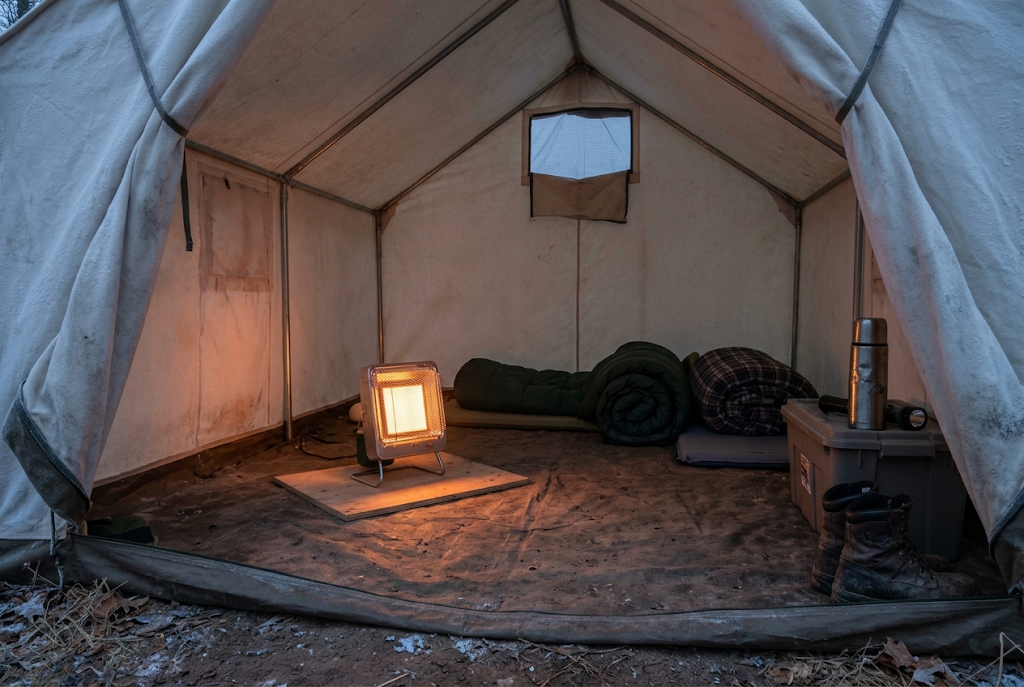
Tent heater FAQ
Is it safe to use a propane heater in a tent?
It can be, with the right heater and the right habits. Use a heater with a low-oxygen and tip-over shutoff, open vents high and low as the manual says, keep the clearances, run a CO alarm, and shut it off before you sleep.
Can you sleep with a tent heater on?
Not with a propane heater. Mr. Heater’s Buddy and Big Buddy manuals say never to operate the heater while sleeping. Heat the tent, shut the heater off, and let your sleeping bag do the work overnight.
What size heater do I need for a wall tent?
For a 10×12 to 12×14 wall tent, a three-setting heater like the Big Buddy (rated to 450 sq ft) or a wood stove is the usual choice. Larger canvas tents are where wood stoves and diesel heaters earn their keep.
How do you heat a tent without electricity?
Portable propane heaters, wood stoves in tents built for them, and diesel heaters with outside exhaust all work without hookup power. Diesel heaters do need a small 12V supply for the fan and pump.
Do I need a CO detector for camping?
Yes, any time a fuel-burning heater runs in or near your tent. A battery-powered CO alarm is cheap insurance.
The bottom line
For most hunting camps, the Mr. Heater Big Buddy is the heater to buy: three heat levels, a low-oxygen shutoff, and enough output for a wall tent. Go smaller with the Portable Buddy for a topper or dome tent, and step up to a wood stove or diesel heater for a long base camp. Whatever you choose, the CO alarm and open vents matter more than the brand.
What do you run at camp? Tell us in the comments.